Disclosure: Brio Reach publishes this review free of charge. We earn no commission from any provider on this page, and none of the links are affiliate links. Prices and plan details change often. Every price below was checked against provider pages and recent reviews in 2026. Confirm the current price on the provider’s site before you buy.
You land, switch off airplane mode, and want three things within a minute: a map, a ride app, and a message home. The best eSIM for travel gives you that without a SIM shop queue or a $100 roaming bill.
Quick answer: For most travelers in 2026, Brio Roam is our top pick for the best eSIM for travel, thanks to 200+ destinations, country, regional, and global plans, bundles that include data, voice minutes, and SMS, and 24/7 customer support. Airalo is a strong budget choice for light users, Holafly suits people who want unlimited data on a phone-only trip, and Saily fits travelers who want security tools in the app. The right pick depends on how much data you use, how many countries you visit, and whether you need a phone number.
This guide compares eight travel eSIM providers on price structure, coverage, data allowances, hotspot rules, activation, and support. You will also find a data calculator, a destination guide for Europe, the USA, and Asia, and a checklist of the fine print that trips people up.
Table of Contents
Best eSIM for Travel: Quick Picks
- Best eSIM for travel overall: Brio Roam
- Best budget eSIM for light users: Airalo
- Best for unlimited data on one device: Holafly
- Best for security features: Saily
- Best for frequent travelers who hate setup: Ubigi
- Best per-GB value in Europe: Nomad eSIM
- Best for testing a destination cheaply: Jetpac
- Best for calls and a pay-as-you-go global eSIM: Roamless
Travel eSIM Comparison Table (October 2026)
| Provider | Coverage (as advertised) | Plan style | Unlimited option | Calls/SMS | Best for |
|---|---|---|---|---|---|
| Brio Roam | 200+ destinations | Country, regional, global; fixed GB and unlimited | Some destinations | Data + Voice + SMS plans (e.g., USA, Global) | Most travelers |
| Airalo | 200+ countries and regions | Fixed GB: local, regional, global | Some destinations | Mostly data-only | Short trips, light data |
| Holafly | 200+ destinations | Unlimited by number of days, plus monthly plans | Yes, all plans | Number on subscription only | Heavy phone use |
| Saily | 200+ destinations | Fixed GB, some unlimited, monthly Ultra plan | Some destinations | Optional US number | Privacy-minded travelers |
| Ubigi | 201 destinations | One-off, monthly, annual | Some destinations | No | Repeat travelers |
| Nomad | Major regions, fewer plans per country | Fixed GB, Nomad Pass subscription | Limited | No | Europe on a budget |
| Jetpac | 96 countries (per TechRadar testing) | Fixed GB and capped “unlimited” | Throttled after 3 GB/day | Outgoing calls on select plans | Low-cost trial runs |
| Roamless | 200+ destinations | Pay-as-you-go global credit, fixed plans | No true unlimited | In-app calls, numbers by subscription | Calls, country hopping |
Coverage counts come from each provider’s own marketing or published reviews. Some brands count regions such as “Europe” as a destination, which inflates the number.
How We Picked the Best eSIM for Travel
We did not rank providers by brand size, and no provider paid for its position. Brio Reach earns no commission from this page. We compared published plan terms and real user reports across seven factors that decide whether an eSIM works for you on the ground:
- Coverage and network partners in the countries most people visit
- Price structure: per GB, per day, or subscription, and what that means for your trip length
- What “unlimited” means: the daily high-speed cap before throttling
- Hotspot rules: allowed, capped, or blocked
- Activation timing: does the plan start on install or on arrival?
- Top-ups: can you add data without Wi-Fi?
- Support: channels, hours, and refund terms
This review is based on each provider’s published plans and terms, checked in October 2026, plus independent 2026 reviews and public user feedback. We did not run our own speed tests for this guide, so we do not quote speed figures we cannot back up.
The Best eSIMs for Travel, Reviewed
1. Brio Roam: Best eSIM for Travel Overall
Brio Roam is our top choice because it covers more trip types from one place than most rivals. You can buy a single-country plan, a regional plan, or a global plan, and some plans include voice minutes and SMS as well as data. That last point matters: most travel eSIMs on this list are data-only.
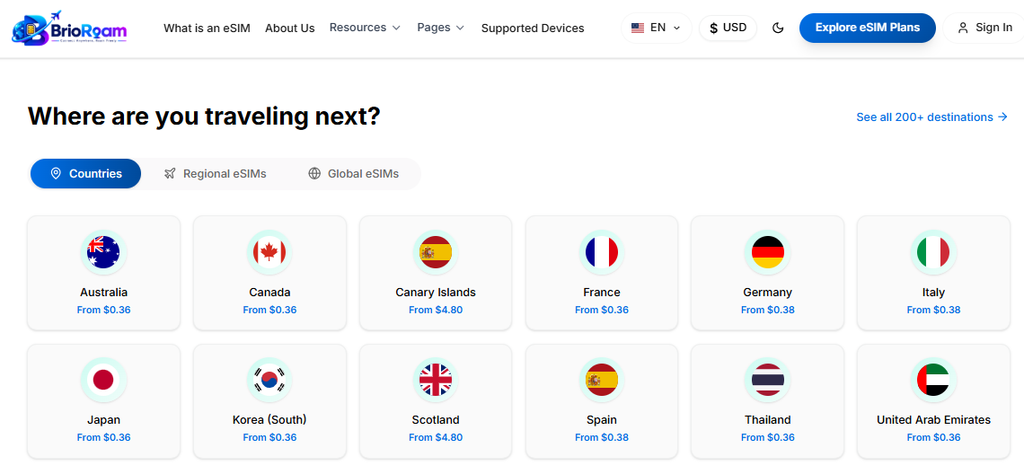
What you get (checked on brioroam.com, October 7, 2026):
- Coverage: 200+ destinations. The site lists 3,728 packages across 263+ destinations, a count that includes regions.
- Country plans: Start from $0.36 for the smallest packages in Australia, Canada, France, Japan, South Korea, Thailand, and the UAE. Germany, Italy, and Spain start from $0.38.
- Regional plans: Europe (42 countries) from $3.60, European Union and UK (28 countries) from $0.54, Asia (18 countries) from $0.72, Middle East (17 countries) from $2.16, Caribbean (28 countries) from $3.60, Latin America (17 countries) from $8.40, and Africa (36 countries) from $13.20.
- Global plans: Sizes from 200 MB to 1 GB with 1 to 30 days of validity, plus a global bundle with calls and texts.
- Unlimited data: Available in some destinations, for example Ecuador unlimited for 3 days at $22.80.
- Other features listed: Hotspot sharing, instant eSIM activation, 24/7 customer support, and you keep your physical SIM for your home number.
- Rating: Brio Roam’s homepage shows a 4.7/5 rating with 50K+ downloads.
Data + Voice + SMS bundles:
| Plan | Data | Calls | SMS | Validity | Price |
|---|---|---|---|---|---|
| USA | 5 GB | 50 min | 50 | 7 days | $20.40 |
| USA | 20 GB | 200 min | 200 | 15 days | $54.00 |
| USA | 20 GB | 200 min | 200 | 30 days | $56.40 |
| Global | 10 GB | 100 min | 100 | 180 days | $94.80 |
Sample data-only prices from the popular plans page:
| Plan | Data | Validity | Price |
|---|---|---|---|
| Asia | 1 GB | 1 day | $3.60 |
| Oceania | 3 GB | 30 days | $6.36 |
| Caribbean | 5 GB | 30 days | $32.28 |
| Ecuador | Unlimited | 3 days | $22.80 |
Pros
- Data + Voice + SMS bundles, so you get a real number for calls, taxis, and SMS codes
- Wide choice: country, regional, and global plans across 200+ destinations
- Very low entry prices for short trips, and long 180-day validity on the global bundle
- Hotspot sharing and 24/7 support listed on the site
Cons
- The lowest “from” prices apply to the smallest packages, so compare price per GB for longer trips
- Unlimited plans are not offered everywhere
- Check each plan’s details for activation timing and any fair-use limits before you buy
Best for: Travelers who want one provider for any trip type, and anyone who needs calls and texts as well as data, such as business trips to the USA or long multi-country journeys.
Example: A one-week trip to the USA with maps, messaging, and a few local calls fits the 5 GB, 50-minute, 50-SMS plan at $20.40. A two-week trip through France, Italy, and Spain fits a regional Europe plan, which starts at $3.60.
2. Airalo: Best Budget eSIM for Light Users
Airalo is the name most people hear first, and it earns that position with breadth. It sells local, regional, and global eSIM plans in more than 200 countries and regions, and hotspot use is supported.
Pricing: Entry plans sit around $4. A Europe plan of 1 GB for 7 days was about $4 in 2026, with 20 GB for 30 days around $39.
Pros
- Huge destination list with clear country coverage on each regional plan
- Cheap entry point if you mainly use maps, WhatsApp, and email
- Hotspot supported
Cons
- Fixed-GB plans mean you track usage and top up if you run short
- Support runs through in-app chat and WhatsApp, with no phone line
- Most plans are data-only
Best for: Weekend breaks and short trips where you rely on hotel Wi-Fi and need data only when you are out.
3. Holafly: Best eSIM for Unlimited Data on One Device
Holafly sells plans by number of days, and every plan includes unlimited data. You pick the destination and trip length and stop counting gigabytes.
Pricing examples (2026): Europe for 5 days was about $19.50, and 30 days about $74.90. Holafly Plans, the monthly subscription covering 160+ destinations, listed 25 GB for $49.90 and unlimited for $64.90 per month.
Pros
- No data math on short trips
- “Always On” gives 1 GB of emergency data per month in 150+ destinations
- Large network partners in major markets
Cons
- Hotspot sharing is restricted on many plans. One long-term reviewer reported a cap near 500 MB per day
- Testers have reported slower speeds after heavy daily use, around 3 to 5 GB depending on the country
- Costs more than fixed-GB rivals if you use little data
Best for: Phone-only travelers who watch video, upload photos, and do video calls daily.
4. Saily: Best eSIM for Security Features
Saily comes from the team behind NordVPN. The app includes an ad blocker, web protection, and a virtual location tool. It covers 200+ destinations and offers 24/7 live chat in the app.
Pricing: Short plans start under $4. Saily Ultra, a monthly global plan, costs $59.99 with unlimited data and extras such as lounge access. You can add a US (+1) number for $0.99 per month.
Pros
- Security tools built into the app
- Optional US number for calls, texts, and 2FA codes
- One eSIM that you top up for new trips
Cons
- Unlimited plans slow down after 5 GB of high-speed data per day
- First activation needs Wi-Fi
- The security tools only apply to traffic on the Saily data connection, not your hotel Wi-Fi
Best for: Travelers who handle work email and banking on the go and want extra filtering.
5. Ubigi: Best for Frequent Travelers
Ubigi covers 201 destinations, with 5G in 90 of them according to TechRadar’s 2026 testing. Two features stand out. Plans start only when you first connect abroad, and the app lets you top up even when your data runs out.
Pros
- Install once and add new plans per trip, with no new QR code
- One-off, monthly, and annual plan options
- Validity starts on arrival
Cons
- No voice or SMS add-ons
- Support can be slow, based on tester reports
- Not always the cheapest per GB
Best for: People who travel several times a year and want to skip setup each time.
6. Nomad eSIM: Best Per-GB Value in Europe
Nomad competes on price. European plans have been reported from about $0.66 per GB, and the Nomad Pass subscription costs $3 per month for 1 GB of Europe data plus 15% off add-ons.
Pros
- Low per-GB price on popular routes
- Quick setup, about five minutes in tests
- Subscription option for regular trips
Cons
- Fewer plan choices per country outside Europe
- Speeds depend on the local partner network
Best for: Budget travelers on a multi-country Europe route who use a moderate amount of data.
7. Jetpac: Best for Testing a Destination Cheaply
Jetpac often runs a $1 trial for 1 GB, which lets you check coverage before you commit. Its SmartDelay feature gives free airport lounge access when your flight is delayed.
Pros
- Cheap trial to test speed in your destination
- Fast support replies in tester reports
- Lounge perk for delayed flights
Cons
- Covers 96 countries, fewer than most rivals
- “Unlimited” plans slow down after 3 GB per day
- Some Android phones need manual APN setup
Best for: Frequent flyers and light users who want a low-risk first try.
8. Roamless: Best for Calls and Pay-As-You-Go Data
Roamless works differently. You buy global credit for one eSIM, and the cost per GB depends on where you are. Credit on the Flexible plan does not expire. The app also supports international calls, and you can get a phone number with a subscription.
Pros
- One global eSIM, no switching between countries
- In-app calling to landlines and mobiles
- Unused credit carries over
Cons
- Higher per-GB cost than a fixed country plan
- No true unlimited plan
Best for: Country hoppers and anyone who needs to call hotels, restaurants, or banks.
Which eSIM Is Best for International Travel?
The best eSIM for international travel is the one that matches your trip, not the one with the biggest ad budget. Use this table to narrow it down in 30 seconds.
| Your trip | Data you need | Best plan type | Good fit |
|---|---|---|---|
| 4-day city break, one country | 1 to 3 GB | Local fixed-GB plan | Brio Roam, Airalo, Nomad |
| 2 weeks, three or more countries in Europe | 5 to 15 GB | Regional Europe plan | Brio Roam, Nomad, Airalo |
| 10 days, you stream and post daily | 20+ GB | Unlimited by days | Holafly, Saily |
| Remote work abroad, laptop tethering | 30+ GB | Large fixed plan with hotspot | Brio Roam, Airalo |
| Several trips a year | Varies | Reusable eSIM or subscription | Ubigi, Saily Ultra, Holafly Plans |
| You need calls and texts, or a US number | Any | Data + Voice + SMS, or data plus number | Brio Roam, Roamless, Saily |
A practical rule: if your daily use stays under about 1 GB, fixed-GB plans almost always cost less than unlimited. If you burn through 3 GB or more a day on your phone alone, unlimited usually wins.
Best eSIM for International Travel in Europe
Europe is the most common eSIM trip, and regional plans make sense once you visit two or more countries. One Europe eSIM covers the border crossing from France to Italy without any action on your part.
Before you buy an eSIM for Europe, check three things:
- The country list. Regional plans often exclude the UK, Switzerland, Turkey, or the Balkans. A traveler heading London to Paris to Zurich needs all three on the list.
- Validity versus trip length. Add two or three days of buffer for delays.
- Your home plan. If you live in the EU, “Roam like at Home” may already cover you. An eSIM is still useful for non-EU countries on the same trip.
Example budget: A 14-day Europe trip with daily maps, messaging, and some social media typically needs 5 to 10 GB. On a regional fixed plan, that usually costs less than a two-week unlimited plan.
Best eSIM by Destination: USA, Asia, and Beyond
eSIM for USA: US networks have wide coverage in cities, with gaps in national parks and rural highways. Check which carrier the plan uses. Large US networks usually give better rural coverage than smaller partners.
eSIM for Asia: Japan, South Korea, Thailand, and Singapore have fast networks and strong eSIM support. For a multi-country Southeast Asia trip, a regional Asia plan saves you from buying three or four country plans.
China: Apple notes that in mainland China, only the iPhone 17e and iPhone Air support eSIM. Check your phone model before buying a China plan. Also check whether the plan gives access to apps such as Google and WhatsApp, since some do and some do not.
Middle East and Africa: Coverage varies more by provider here. Check the partner network for each country, and buy a small test plan before committing to a large one.
Best eSIM for Travel With Unlimited Data
“Unlimited” rarely means full speed all day. Most unlimited data eSIM plans use a fair-use policy: you get a set amount of high-speed data per day, then speeds drop.
Reported daily caps in 2026:
- Jetpac: slows after 3 GB per day
- Saily: slows after 5 GB per day on unlimited plans
- Holafly: testers reported slowdowns around 3 to 5 GB, depending on country and network
- Sim Local: up to 10 GB of high-speed data per day on unlimited plans, per a long-term reviewer
- Brio Roam: unlimited plans in some destinations, such as Ecuador (3 days, $22.80). Check the plan details for any fair-use limit
Also check hotspot rules. Several unlimited plans block or cap tethering. If you plan to work from a laptop, a large fixed-GB plan with full hotspot support can serve you better than “unlimited.”
Which eSIM App Is Best for Travel?
A good eSIM app saves you time when something goes wrong. Here is what to look for:
- Top-up without Wi-Fi. Ubigi’s app works even with zero data left. This matters at 11 p.m. in a train station.
- Usage tracking with clear remaining data and days.
- Live support inside the app. Saily and Airalo offer in-app chat.
- One reusable eSIM. Ubigi, Saily, and Roamless let you add new plans to the same eSIM, so you skip the QR code each trip.
- Brio Roam: shows a 4.7/5 rating with 50K+ downloads on its homepage, plus 24/7 support and instant activation.
If a provider has no app, you can still manage plans on the website. That works fine for one short trip.
Best eSIM for Travel: What Reddit Users Say
Search “best eSIM for travel Reddit” and you will find long threads in travel subreddits. The provider names change from thread to thread, but the advice repeats:
- Buy a small plan first. Test speeds when you land, then buy more data from the provider that works.
- Compare on a price site. Commenters often point to comparison sites such as eSIMDB to check prices per GB across providers.
- Read the throttle terms. Complaints about “unlimited” plans almost always come from people who did not check the daily cap.
- Install before you fly. Many problems come from trying to install on weak airport Wi-Fi.
- Check that your phone is unlocked. Carrier-locked phones are a common cause of “eSIM won’t work” posts.
Treat Reddit as a source of patterns, not proof. A single bad review can come from a locked phone or a wrong country plan.
How Much Data Do You Need for Travel?
Most people overbuy. Use these figures to plan.
| Activity | Approximate data use |
|---|---|
| Netflix on “Low” quality | Up to 0.3 GB per hour |
| Netflix on “Medium” quality | Up to 0.7 GB per hour |
| Netflix in HD | Up to 3 GB per hour |
| Netflix mobile “Automatic” setting | About 4 hours per GB |
| Messaging, email, navigation | Usually under 100 MB per day for most people |
| Video calls | Several hundred MB per hour |
Netflix figures come from Netflix’s help page on data usage. Other figures are rough estimates and vary by app and settings.
Sample budgets:
- Light user, 7 days (maps, WhatsApp, some browsing): 2 to 3 GB
- Average user, 7 days (plus social media and a few video calls): 5 to 8 GB
- Heavy user, 7 days (streaming, uploads, hotspot): 15 GB or unlimited
Save data before you go: download offline maps for your destination, set apps to update on Wi-Fi only, and set streaming apps to a lower quality on mobile data.
eSIM vs Roaming vs Local SIM
| Option | Cost | Setup | Keeps your number? | Best when |
|---|---|---|---|---|
| Travel eSIM | Low to medium, prepaid | Install before you fly | Yes, alongside your main line | Most trips |
| Carrier roaming | Often high daily fees | None | Yes | Very short trips, or your plan includes roaming |
| Local SIM card | Often cheapest per GB | Store visit, sometimes a passport and forms | Only on dual-SIM phones | Long stays in one country |
A travel eSIM is a strong roaming alternative because it runs next to your home line. You keep your number for SMS codes and use the eSIM for travel data. If you plan to stay in one country for months, a local SIM may still cost less.
eSIM Compatibility: Check Before You Buy
New to eSIMs? Start with our guide on what an eSIM is and how it works when you travel. eSIM is a GSMA standard for remote SIM provisioning, and most recent smartphones support it. Still, check three things:
- Your model supports eSIM. Most iPhones from the XS onward do, along with Google Pixel 3a and later, and recent Samsung Galaxy flagships. On Google Pixel, dual SIM support starts at the Pixel 3a, and Pixel 7 or later can run two eSIM profiles at once.
- Your phone is unlocked. Apple states that your iPhone cannot be locked to a carrier if you want to use another provider abroad. On iPhone, go to Settings > General > About and look for “No SIM restrictions.”
- Regional exceptions. Phones sold in some markets, such as mainland China, may lack eSIM support.
Quick test: dial *#06#. If you see an EID number, your phone has an eSIM chip. Your carrier lock status still needs checking separately.
How to Install and Activate a Travel eSIM
- Buy your plan at home and check the country list one more time.
- Install over stable Wi-Fi, one or two days before departure. Scan the QR code, use the app, or use one-tap install on supported iPhones.
- Label the line “Travel” so you can tell your lines apart. With iOS 26, Apple may ask if the eSIM is for travel and let you choose “Travel eSIM Only” or keep both lines active.
- Keep the eSIM switched off until you land if your plan starts on first connection.
- On arrival: set the travel eSIM as your mobile data line and turn on data roaming for that line.
- Turn off data roaming on your home line to avoid charges. You can keep it on for calls and SMS if your carrier’s rates allow.
Do not delete the eSIM until your trip is over. Many providers cannot reissue a deleted QR code.
7 Things to Check Before You Buy Any eSIM
- Activation trigger: install, purchase, or first connection abroad?
- Daily high-speed cap on unlimited plans
- Hotspot policy: allowed, capped, or blocked
- Country list on regional plans
- Top-up method and whether it needs Wi-Fi
- Refund terms for an eSIM that never connects
- Support hours in your destination’s time zone
Spend two minutes on this list and you will avoid most of the problems people post about after their trip.
Frequently Asked Questions
Which eSIM is best for international travel?
For most travelers, Brio Roam is our top pick for international travel. Airalo suits light users on a budget, Holafly suits heavy phone users who want unlimited data, and Saily suits travelers who want built-in security tools. Match the plan type to your data use and number of countries.
Which brand of eSIM is best for international travel?
There is no single winner for every trip. Brio Roam ranks first in our comparison for overall value and coverage. Airalo, Holafly, Saily, and Ubigi are also reliable brands with 200+ destinations each. Pick the brand whose plan structure fits your trip.
What is the best eSIM card for travel?
A travel eSIM is digital, so there is no physical card to buy. The best travel eSIM is the plan that covers every country on your route, gives you enough data, and starts on arrival rather than on installation.
Which eSIM app is best for travel?
Look for an app that lets you top up without Wi-Fi, shows remaining data clearly, and offers live chat. Ubigi’s app works with zero data left, and Saily and Airalo offer in-app chat support.
Can I keep my WhatsApp and phone number with a travel eSIM?
Yes. WhatsApp stays linked to your number, not your data line. Keep your home SIM active for SMS codes and use the eSIM for data.
Is an eSIM cheaper than international roaming?
Usually, yes. Carrier day passes can add up fast on a two-week trip, while a prepaid travel eSIM charges a fixed amount upfront. Check your own carrier’s rates, since some plans include free roaming in certain countries.
Does a travel eSIM include calls and texts?
Most travel eSIMs are data-only. Use WhatsApp, FaceTime, or similar apps for calls. If you need calls and texts, Brio Roam sells Data + Voice + SMS bundles (for example 5 GB, 50 minutes, and 50 SMS in the USA for $20.40). Roamless and Saily’s optional US number are other options.
When should I install my travel eSIM?
Install it one or two days before you fly, on stable Wi-Fi. Check whether your plan’s validity starts on installation or on first connection abroad.
Final Verdict: Choosing the Best eSIM for Travel
For most people, Brio Roam is the best eSIM for travel in 2026 because it combines 200+ destinations, country, regional, and global plans, and Data + Voice + SMS bundles that most rivals do not offer. If your trip is short and your data use is light, Airalo or Nomad will keep costs low. If you stream and post all day on one phone, Holafly is the simpler choice. If you travel several times a year, a reusable eSIM from Ubigi or a subscription such as Saily Ultra saves setup time.
Whatever you pick, buy a small plan first if you are unsure, read the throttle and hotspot terms, and install before you fly.
Check Brio Roam eSIM plans for your destination
About the author
Sana Ullah Shinwari is Co-Founder and President of Brio Reach. He researches and compares digital products, including travel eSIMs, for Brio Reach readers.
Prices, coverage, and plan terms were checked in 2026 and can change without notice. Always confirm current details on the provider’s website before you buy.